

Chapter Eight: The Cup That Changed The World, Part I
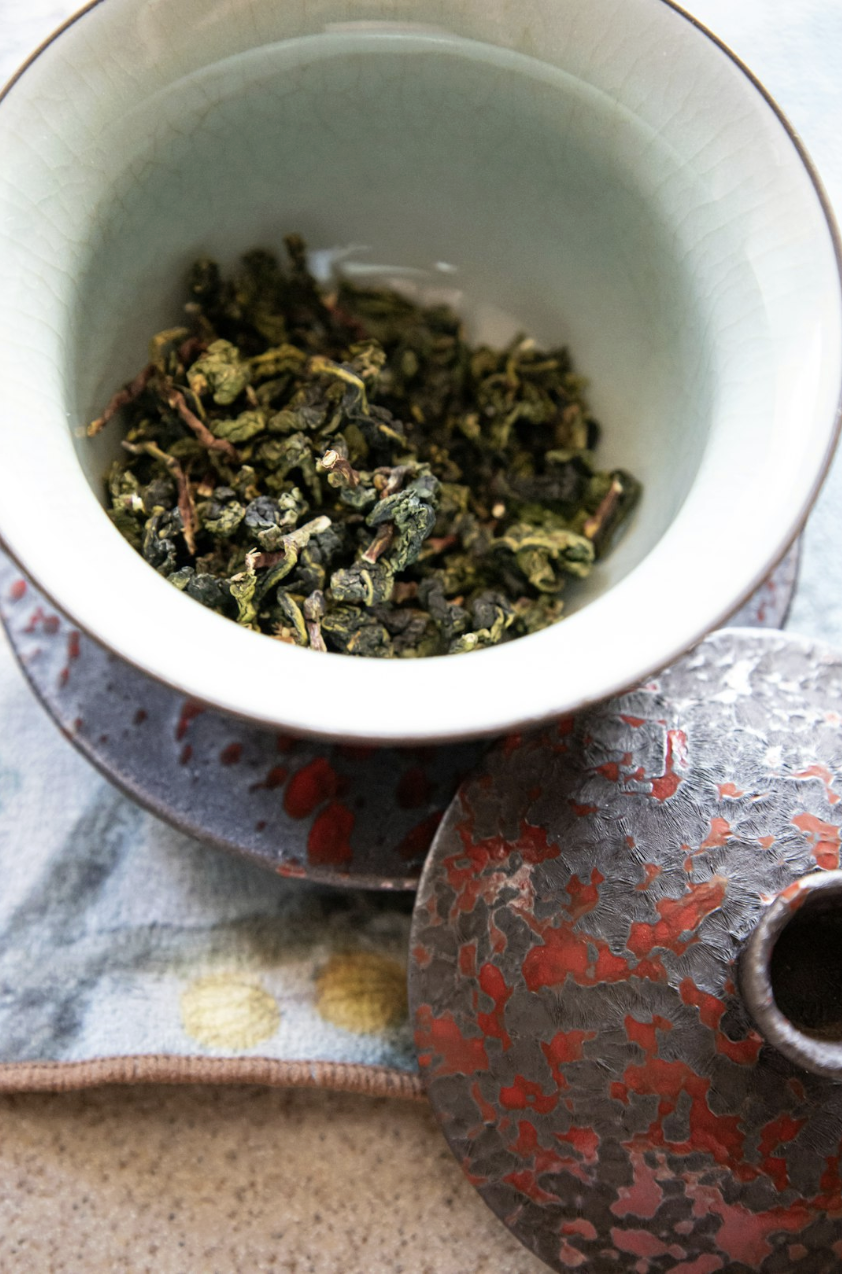
Photo by Julia Igosheva on Unsplash
There is a moment, somewhere in the mountains of Yunnan, China where a farmer presses freshly steamed tea leaves into a stone mold and produces a cake of pu-erh that will not be drunk for twenty years. Someone who has never met the eventual drinker, perhaps someone not even born yet, will one day crack it apart, brew it, and taste something the farmer shaped with his hands today.
Tea does that to people. It compresses centuries into a single cup.
I have been studying tea for years but still have so much to learn. What I keep encountering is not what I expected. Tea is not a gentle or whimsical story. It is a story of obsession, of empire, of chemical dependency, of philosophy, of war. It is also, at its core, a story about how human beings make meaning out of the act of sitting still.
I love telling this kind of story.
The Plant Before the Ritual
Let us begin with the biology, because the ritual cannot be separated from the chemistry.
Camellia sinensis, the tea plant, produces leaves that contain caffeine, theanine, and a dense family of polyphenols. Caffeine is the stimulant everyone knows. But theanine is actually more interesting: it is an amino acid that promotes alert calm, dampening the jittery edge of caffeine while extending its focus. This combination is genuinely unusual in nature. It is part of why tea produces a mental state distinct from coffee, alcohol, or anything else humans have consumed in mass quantities.
The earliest credible written references to tea come from China around the 3rd century CE, though botanical evidence suggests people in the Yunnan-Sichuan-Guizhou triangle were interacting with the plant for far longer, likely chewing the raw leaves for their stimulating properties. The leap from leaf-chewing to infusion (boiling or steeping in water) was the technological shift that made everything else possible. It made tea scalable, shareable, and ultimately civilizational.
China classified tea not as a beverage but as a medicine. The Tang dynasty text Cha Jing, written by Lu Yu around 760 CE, is often called the first book devoted to tea. It is a great read and one that I highly recommend to tea lovers. It is meticulous to the point of obsession: the quality of water, the shape of the flame, the proper season for picking, the correct grade of leaf. Lu Yu was constructing a philosophy, one in which the preparation of tea was itself a form of attention, a discipline that sharpened perception of everything else. The Cha Jing is less a how-to and more a why-bother.
The Road to Japan: How a Beverage Became a Practice
Tea crossed into Japan via Buddhist monks in the 9th century. What happened next is one of the more extraordinary cultural transformations in history.
The Japanese did not simply adopt a Chinese drink. They systematically rebuilt it as a different kind of experience. By the 12th century, the monk Eisai had introduced matcha (powdered tea whisked in a bowl rather than brewed from loose leaf and one of my absolute favorites!) and connected its consumption directly to Zen practice. The stillness required to whisk a bowl of matcha properly, to sit with it, to drink it without distraction, mapped precisely onto meditative discipline.
Then came Sen no Rikyu in the 16th century, who may be the single most consequential figure in the history of tea aesthetics. Rikyu codified what would become chado, also known as the Way of Tea, around four different concepts: wa (harmony), kei (respect), sei (purity), and jaku (tranquility). The tearoom he championed was deliberately small, low-ceilinged, and unadorned. The entrance gate, or the nijiriguchi, was designed so that every guest, regardless of social rank, had to bow to enter. Warlords and servants stooped at the same door.
Rikyu understood something that took the rest of the world much longer to articulate: that the design of a space dictates the behavior inside it. His mission to engineer an encounter between people and how it overlaps into the field of design is incredible and one that I cannot wait to unpack in a separate piece.
He was eventually ordered to commit suicide by the ruler Toyotomi Hideyoshi, in a dispute that historians are still researching and trying to understand. The man who built the most elegant argument for humility was destroyed by a man who wanted none of it. Tea has never been far from power.
The British Addiction and the Opium Trade
When tea arrived in England in the mid-17th century, it was expensive enough to be kept in locked boxes. Samuel Pepys recorded drinking it in 1660 with the same casual note he might use for a curiosity. Within a century, it was the defining national beverage, consumed at every level of society.
This is where the story gets darker, and where most polite tea histories look away.
England’s demand for Chinese tea was enormous and growing. China, however, had limited interest in British goods. The trade imbalance was severe with Britain hemorrhaging silver to pay for tea, silk, and porcelain. The solution the British East India Company arrived at was opium, grown in Bengal and smuggled into China in flagrant violation of Chinese law. By the 1830s, tens of millions of Chinese were addicted. When the Qing government attempted to stop the trade, destroying 20,000 chests of confiscated opium in 1839, Britain declared war.
And my children have at times claimed that history was boring.
The Opium Wars (1839–1842 and 1856–1860) are among the more brazen episodes in colonial history. Britain fought, essentially, for the right to continue drug trafficking. The settlements that followed opened Chinese ports, ceded Hong Kong, and began the period China calls the ‘Century of Humiliation.’ The tea in a Victorian parlor had a long and ugly shadow attached to it.
The British also launched a botanical espionage operation. Robert Fortune, a Scottish plant hunter, disguised himself as a Chinese merchant in the 1840s and 1850s and smuggled tea plants, seeds, and the knowledge of their processing from China to the British colony of India. This was industrial theft on a colonial scale, and it succeeded brilliantly. Assam and Darjeeling became the sources of a new tea empire, one that the British controlled from root to cup.
None of this makes a cup of Darjeeling less exquisite. But it makes the history more honest.
Tea had traveled from a Yunnan mountainside to the locked cabinets of English aristocrats, leaving wreckage and wonder in equal measure. It had been a medicine, a philosophy, a weapon of empire, and a justification for war — all before most of the world had even tasted it.
But the story I find most surprising is what happened when it arrived somewhere that had no interest in empire at all — only in the question of what it means to welcome a stranger.
Stay tuned for Part 2 that continues the journey: from the tea glasses of Iran to the silver trays of Morocco, from the objects in my own collection to the argument I have been building.
With Curiosity,
The Lifestyle Historian
